
24 September 2026
Anna Bon: aid to Ukraine works when it is built as a partnership rather than as charity
The Foundation's co-founder has written about why Ukraine should speak to its international partners in the language of interests and results. For the Foundation this is not an abstraction: it has worked that way from the start.
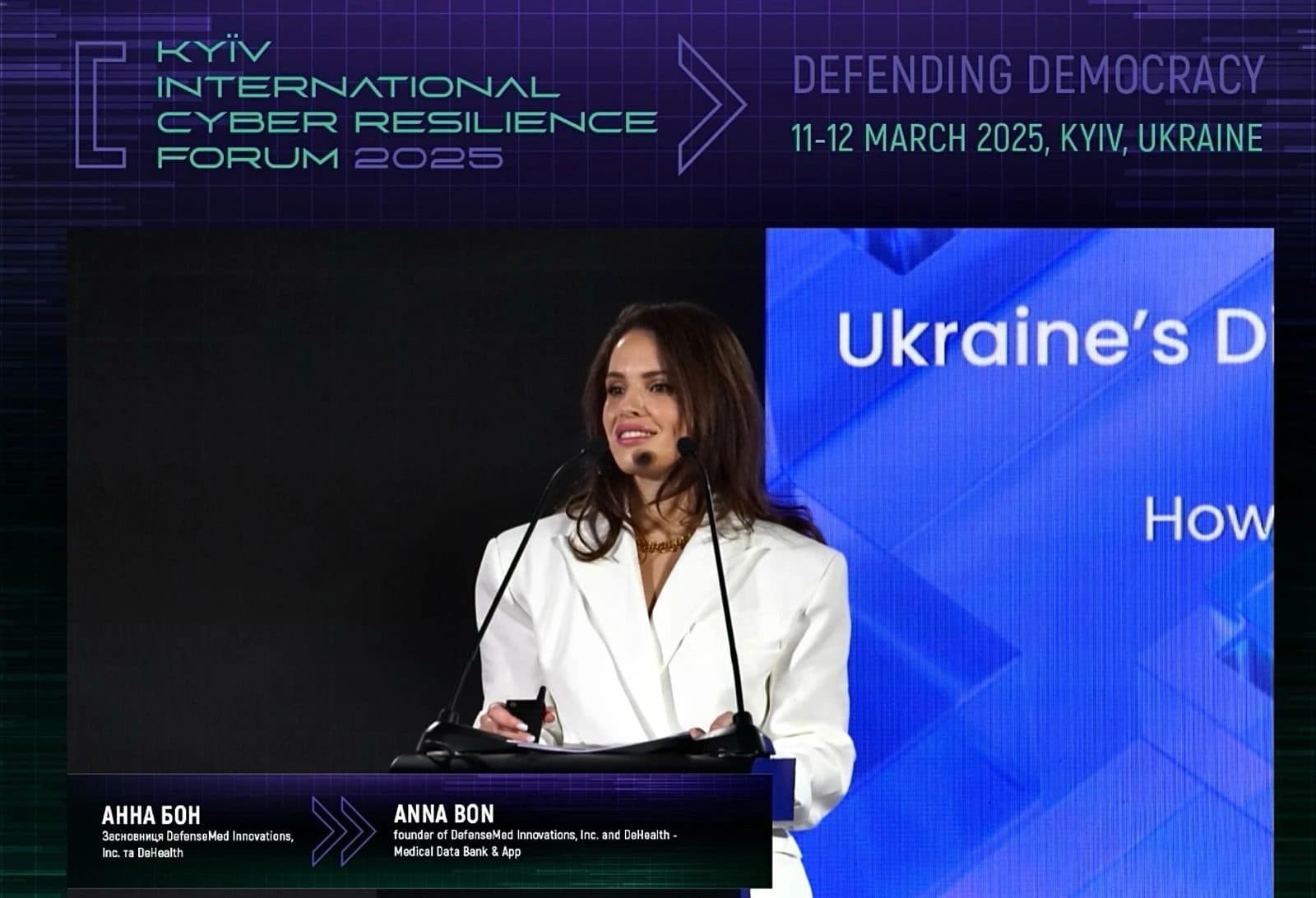
Anna Bondarenko (Anna Bon), co-founder of the DeHealth Charitable Foundation, has written about how Ukraine and Europe talk to the United States. Ukrainian News covered the piece.
Her central point: our arguments are excellent, but we too often bring proof that we are right to a table where what is expected is a structure. Who does what, who is accountable, and what each side gets out of it.
«The problem is that Ukraine and Europe very often talk to America as if Americans were simply slightly richer Europeans, as if it were a big Europe. And it is not Europe. It is not about that at all.»
She describes the difference plainly. A European official walks into the room with a norm: there is law, there is procedure, there is principle. An American walks in with four questions. What do you want. What do I get. Who pays. What does this look like in ten years.
«We talk about historical justice. They ask: what are you proposing? We explain why we need it. They answer: understood, and what is it for us?»
And she heads off the charge that this is cynicism. In that culture counting is a form of respect: if someone is running the numbers on your project, they are taking you seriously.
«Taking offence at being counted is roughly like taking offence at a doctor for asking for test results instead of offering sympathy.»
Why this matters to a charitable foundation
For us this is not a theoretical discussion. The Foundation has worked on a partnership model rather than a donation model from the start. We have no bank account, we do not accept monetary donations from individuals or businesses, and never have. Medicines, medical equipment and expertise come to us from foreign states, corporations and partner organisations, and we then coordinate their delivery to verified recipients with no intermediaries and no mark-ups.
That model rests on exactly what Anna describes. A partner has to understand what they are giving, where it goes, who is accountable for it, and how the result can be seen.
So every request that reaches us is checked: confirmation from the unit's commander, coordination with military structures where that is needed, a cross-check through independent partners. Even when it delays delivery by a day or two. Then logistics by the shortest route and only through suppliers we have vetted. On larger campaigns we work with partners in Poland, Czechia and Germany who receive shipments from third countries.
After delivery there is a report with documented proof of receipt: handover acts signed by the recipient, photographs, letters of thanks. That documentation is published on the project pages. Not because anyone requires it, but because without it a partnership does not happen a second time. A partner comes back not when they have been persuaded, but when they have seen that the previous delivery reached the people it was meant for, and that this can be checked.
The numbers worth looking at
The piece cites an estimate by Roksolana Pidlasa, chair of the parliamentary budget committee: one day of the war costs the state budget roughly 190 million dollars, not counting weapons supplied by partners. In 2024 it was 140 million. The draft 2027 budget puts defence and security at about two thirds of all state expenditure.
«The war is gradually ceasing to be a line in our budget. It is becoming its architecture.»
Against that, the state of the US-Ukraine Investment Fund. In January the US DFC opened an online portal for project submissions: energy, transport and logistics, communications, new technologies, critical minerals. According to deputy economy minister Yehor Perelyhin, more than three hundred projects had been submitted by early September, over 60 per cent of them in energy. One was approved. None financed.
The reason he gives is not that partners are not listening: most of the projects are fairly raw, without detailed justifications or calculations. The fund's own starting capital is 150 million dollars, less than the country spends in a single day of war.
It matters all the same. When the US treasury secretary announced that one approved investment, he did not say «we will help you»; he said both economies stand to gain. That is the difference between aid and partnership, stated by the other side.
Sovereignty and agency
One more point bears directly on what the Foundation does. This month Europe announced 3.3 billion euro for Ukrainian missiles and drones, and the money has already arrived.
«I am very grateful. But gratitude should not get in the way of arithmetic. A country whose defence depends on a vote in someone else's parliament has sovereignty. It does not yet have agency.»
For a charitable organisation that lives on international partnerships, that is not an abstraction but a description of its own position. Which is why we build the work so that every partner has grounds to come back: not out of pity, but because they saw the result.
«Being right is not enough. You have to build a structure in which it is in your partner's interest that you succeed.»